Portfolio Theory & Construction
From Markowitz's seminal work on mean-variance optimisation to modern factor-based portfolio construction, this section covers the theoretical and practical frameworks that underpin professional portfolio management. Understanding these concepts helps investors evaluate allocation decisions with greater rigour.
Modern Portfolio Theory: The Foundation
Harry Markowitz introduced Modern Portfolio Theory (MPT) in his 1952 paper "Portfolio Selection," published in the Journal of Finance. MPT provides a mathematical framework for constructing portfolios that maximise expected return for a given level of risk, or equivalently, minimise risk for a given expected return. The insight that transformed portfolio management: it is not the risk of individual securities that matters, but their contribution to the total portfolio risk — determined by both individual volatilities and inter-asset correlations.
The key outputs of MPT are:
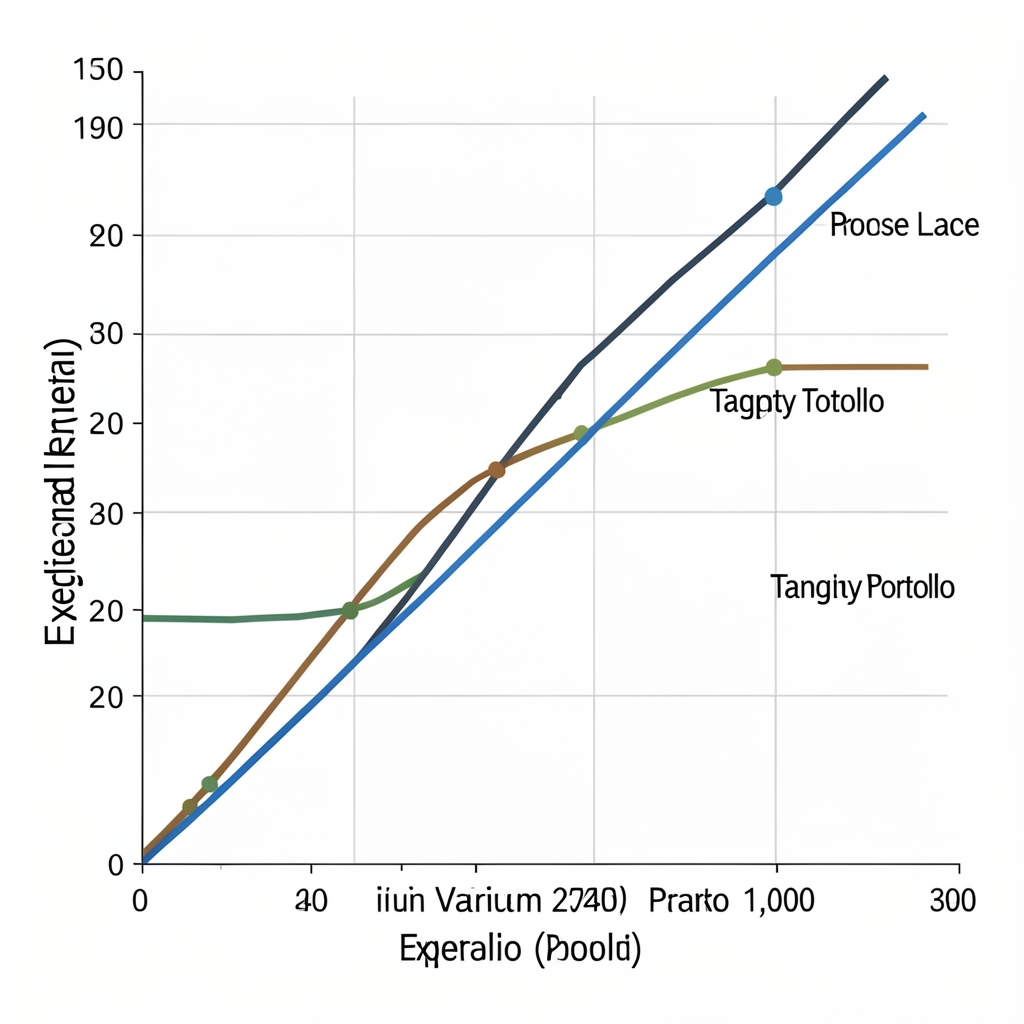
- Efficient Frontier: The set of portfolios offering the maximum expected return for each level of risk. Rational investors should hold portfolios on the efficient frontier.
- Minimum Variance Portfolio: The lowest-risk portfolio achievable given the investment universe.
- Tangency Portfolio: The point on the efficient frontier that maximises the Sharpe Ratio — the optimal risky portfolio when combined with the risk-free asset.
While MPT has significant practical limitations (it is highly sensitive to input assumptions; real-world correlations are unstable; it ignores higher moments like skewness and kurtosis), it provides an essential conceptual vocabulary for portfolio construction and remains the basis for more sophisticated frameworks.
Capital Asset Pricing Model (CAPM)
The Capital Asset Pricing Model (CAPM), developed independently by Sharpe, Lintner, and Mossin in the 1960s, extends MPT by introducing a model for the expected return of any individual asset. The CAPM states that the expected return of an asset is determined solely by its systematic risk (beta) relative to the market:
Where Rᶠ = risk-free rate, βᵢ = asset beta, E(Rₘ) = expected market return, [E(Rₘ) - Rᶠ] = equity risk premium (ERP)
The CAPM provides a baseline for evaluating whether an investment's expected return adequately compensates for its risk. Assets plotting above the Security Market Line (SML) are undervalued (generating positive alpha); those below are overvalued.
Despite its theoretical elegance, the CAPM has been widely challenged empirically. Fama and French (1992) demonstrated that size and value characteristics explain returns beyond beta, leading to the development of multi-factor models.
Equity Risk Premium (ERP) — Danish Context
The Equity Risk Premium is the additional return investors demand for holding equities over risk-free assets. ERP estimates for mature markets like Denmark typically range from 4.5% to 6.5%, based on:
- Historical equity returns versus government bond yields
- Survey-based forward-looking estimates (Damodaran, 2024)
- Implied ERP derived from current market valuations
The current Danish 10-year government bond yield (approximately 2.89% as of mid-2024) serves as the local risk-free rate baseline for ERP calculations. A conservative 5% ERP assumption implies an expected equity return of approximately 7.9% in nominal terms.
Factor Investing: Beyond Single-Factor CAPM
Factor models extend the CAPM by identifying multiple systematic risk exposures that explain cross-sectional return differences. Investing deliberately in assets with positive factor exposures — "factor investing" or "smart beta" — has become a mainstream approach, particularly through factor ETFs.
The original CAPM factor — excess return for bearing market risk. The foundation of all factor models. Captured cheaply through passive index funds.
Small-cap stocks have historically outperformed large-caps (Small Minus Big). The size premium is cyclical, less persistent in recent decades, and partly explained by illiquidity compensation. Fama-French 3-factor model.
High book-to-market (value) stocks have historically outperformed growth stocks (High Minus Low). The value premium has been inconsistent in recent years, leading to debates about its persistence. Fama-French 3-factor model.
Stocks with strong recent 12-month performance tend to continue outperforming in the near term. Momentum is one of the most robust factors empirically but is subject to sharp, rapid reversals (momentum crashes) during market dislocations.
High-quality companies (strong profitability, stable earnings, low debt, high cash conversion) have outperformed low-quality companies. Quality is particularly relevant during economic downturns when financial strength differentiates survivors from distressed companies.
Low-volatility stocks have delivered better risk-adjusted returns than high-volatility stocks — the "low volatility anomaly," contradicting basic CAPM predictions. This phenomenon is partly explained by leverage aversion and benchmarking constraints among institutional investors.
Strategic vs. Tactical Asset Allocation
Strategic Asset Allocation (SAA)
SAA defines the long-term target portfolio weights across asset classes, reflecting the investor's risk tolerance, return objectives, and investment horizon. SAA decisions are driven by capital market assumptions — long-run expected returns, volatilities, and correlations for each asset class. These assumptions are derived from economic theory, long-run historical data, and current valuation indicators.
For a typical Danish private investor with a balanced risk profile and 10-15 year horizon, a representative SAA might include: 55-65% global equities, 25-35% bonds (including Danish realkreditobligationer), 5-10% real assets/alternatives, and 5% cash reserves.
Tactical Asset Allocation (TAA)
TAA involves short-to-medium-term deviations from SAA weights based on near-term market outlook, valuation signals, or macroeconomic forecasts. For example, a value-oriented investor might overweight European equities versus US equities when relative valuations (P/E, P/B multiples) are significantly in favour of Europe.
TAA adds value only if the active deviations generate sufficient excess return to offset transaction costs and the risks of being wrong. Research consistently shows that tactical asset allocation is extremely difficult to implement profitably over time — even for professional investors.
Portfolio Analysis in Every Research Report
Axiom research reports integrate portfolio construction implications into every analysis piece — from sector allocation signals to asset class risk premium assessments.